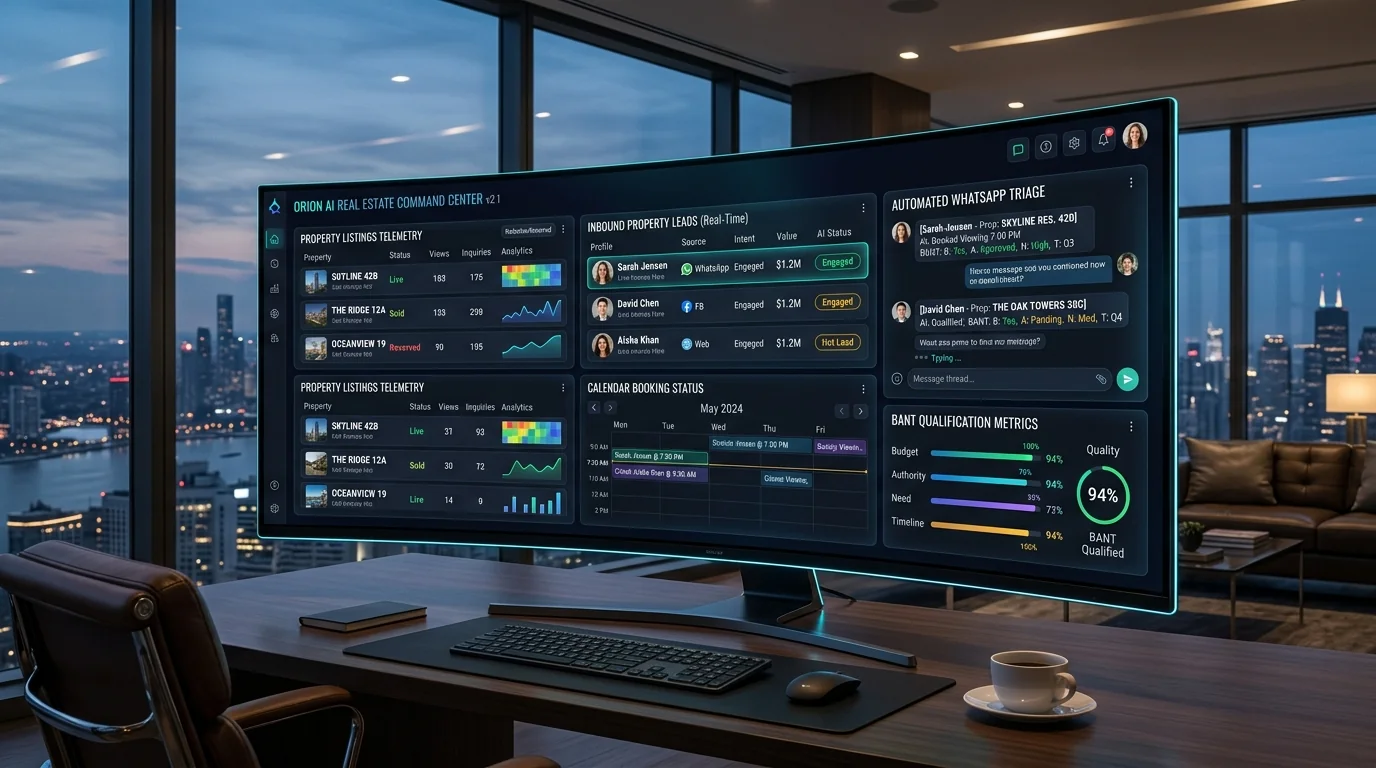
1. The Real Estate Lead Bleed: Why Traditional Routing Fails
Every residential brokerage and property management agency understands the cost of customer acquisition. Companies spend thousands of dollars each month running advertising campaigns across Google Ads, Meta Ads, and specialized property portals such as Zillow, Realtor.com, Bayut, and Property Finder. Despite this investment, the majority of inbound inquiries grow cold before a licensed broker speaks with the prospective buyer.
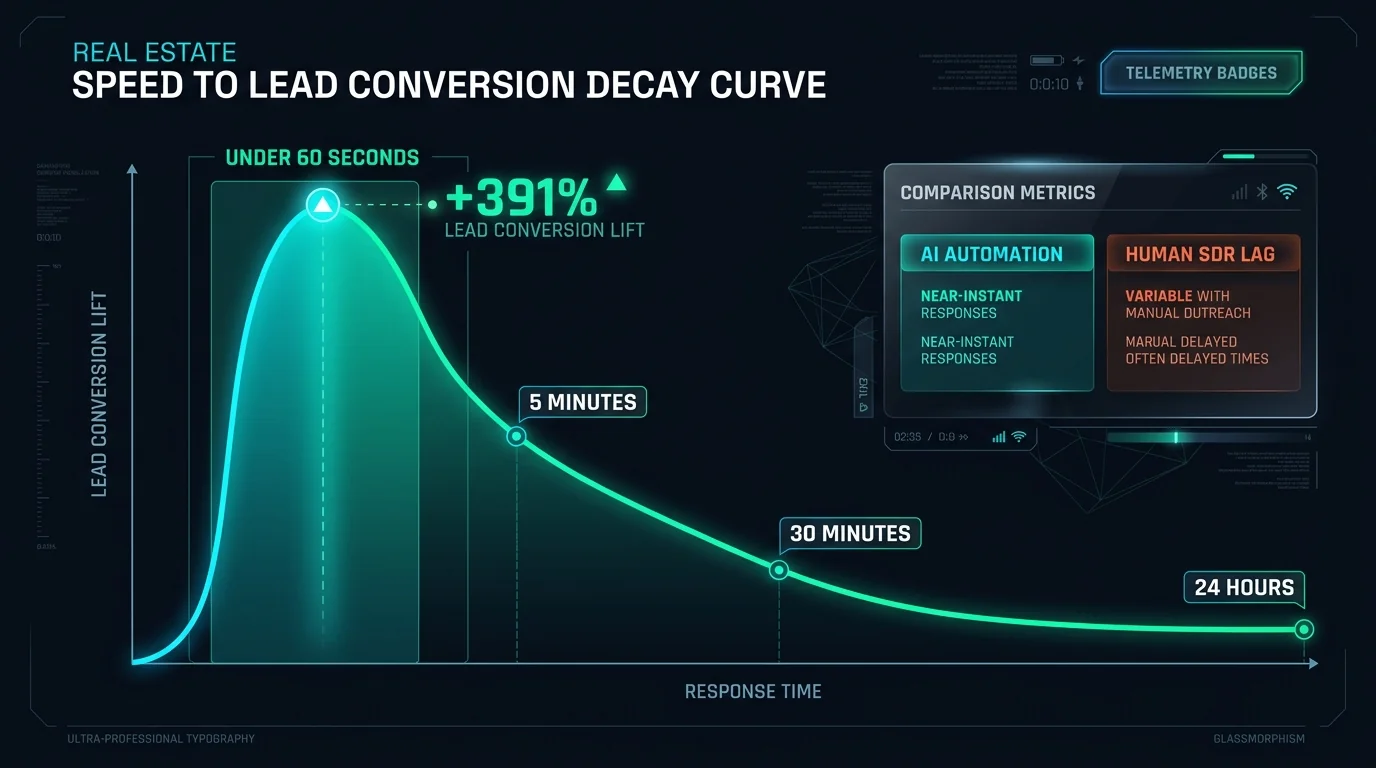
In modern property transactions, buyer intent declines rapidly with each passing minute, demonstrating why AI automation for real estate is essential for lead preservation. When a prospective investor or tenant submits an inquiry regarding a property listing, their attention is focused on that specific asset. If an agency takes two hours or until the following business morning to reply, the prospect has already contacted three competing firms. This operational reality makes AI automation for real estate an indispensable advantage for growing brokerages.
Traditional brokerage operations rely on manual routing protocols. An inquiry arrives via email from a portal, sits in an unmonitored general inbox, gets forwarded to an administrative coordinator, and is eventually assigned to an agent who may be conducting an on-site viewing. This fragmented chain introduces hours of delay. Deploying custom AI automation for real estate removes human intermediaries from initial triage, engaging buyers within seconds while the listing remains visible on their screen.
The financial consequence of lead latency is severe, making AI automation for real estate a direct driver of brokerage profitability. Research on sales velocity indicates that responding to an inbound inquiry within 60 seconds produces a 391% increase in lead-to-opportunity conversion compared to a 30-minute delay. By employing AI automation for real estate, brokerages establish a reliable speed-to-lead engine that operates 24 hours a day, including weekends and late-night browsing windows.
Furthermore, manual lead qualification consumes hours of productive sales time. Real estate agents frequently spend afternoons calling unvetted contacts who lack purchasing power or hold unrealistic expectations. Integrating AI automation for real estate filters casual browsers from serious buyers before human calendars are booked, ensuring sales teams concentrate exclusively on high-value closings.
2. The 4 Operational Workflows Transformed by AI
Successful brokerage leaders recognize that technology must solve practical operational friction rather than generate novelty text. High-performing AI automation for real estate addresses four foundational workflows that consume agent hours and cause deal leakage:
Workflow A: Autonomous Inbound Lead Triage and WhatsApp Qualification
Prospective property buyers resist long web forms containing fifteen mandatory fields, creating strong demand for conversational AI automation for real estate. They prefer conversational channels like WhatsApp, SMS, and direct chat. With AI automation for real estate, an inbound webhook immediately initiates a natural, two-way conversational flow. The autonomous agent identifies itself, confirms availability for the listing, and systematically gathers BANT parameters:
- Budget Verification: Validates whether the buyer has liquid capital or approved mortgage financing matching the listing price point.
- Authority Assessment: Determines if the contact is a principal buyer, an institutional investor, or an outside broker seeking co-brokerage terms.
- Need Identification: Records specific layout requirements, preferred school districts, square footage preferences, or investment yield targets.
- Timeline Expectancy: Identifies when the client intends to close, prioritizing immediate 30-day movers over passive browsers.
This automated interaction functions predictably because AI automation for real estate utilizes structured schema outputs. The model translates messy conversational responses into typed JSON records, ensuring reliable data extraction without conversational drift.
Workflow B: Instant Showing Coordination and Calendar Dispatch
Scheduling property viewings manually involves endless phone calls, text messages, and calendar checks between the listing agent, the occupant, and the buyer, a bottleneck resolved by AI automation for real estate. AI automation for real estate eliminates this logistical overhead. Once a buyer meets qualification criteria, the system connects directly to calendar scheduling APIs such as Cal.com or Google Calendar.
The AI agent presents open viewing slots directly inside the WhatsApp or SMS conversation. When the buyer selects an available window, AI automation for real estate locks the reservation, dispatches calendar invites with property directions, and logs the appointment inside the brokerage CRM. The system also sends automated reminder sequences two hours before the appointment, decreasing showing no-shows by more than 40%.
Workflow C: Tenant Maintenance Ticket Triage and Emergency Dispatch
Property management firms often drown in maintenance requests, highlighting the operational necessity of AI automation for real estate in portfolio operations. Tenants report issues at all hours, describing emergencies poorly or submitting vague complaints. Implementing AI automation for real estate creates an intelligent intake gate for property managers.
When a tenant submits a maintenance ticket with photos via WhatsApp or a web portal, vision-enabled models analyze the image to classify severity. A broken water pipe or sparking electrical outlet is flagged as an urgent emergency, triggering automated notifications to on-call plumbing contractors. Non-urgent issues like a sticky bedroom door are routed to standard maintenance schedules. By handling initial intake, AI automation for real estate protects property managers from midnight emergencies while lowering vendor coordination costs.
Workflow D: Bi-Directional CRM and Document Synchronization
Real estate agents often avoid manual CRM updates, which is why AI automation for real estate automates record synchronization directly from conversation streams. Valuable notes regarding client preferences, conversation histories, and budget changes remain trapped on individual mobile devices. AI automation for real estate establishes a bi-directional pipeline between messaging channels and enterprise CRMs like Follow Up Boss, Salesforce, or HubSpot.
Every conversational interaction, qualification score, and scheduled tour updates the centralized CRM profile automatically. If an agent adds an internal note or updates a listing status inside the CRM, AI automation for real estate immediately synchronizes that context into future automated messages.
3. Production System Architecture: How the Engine Runs
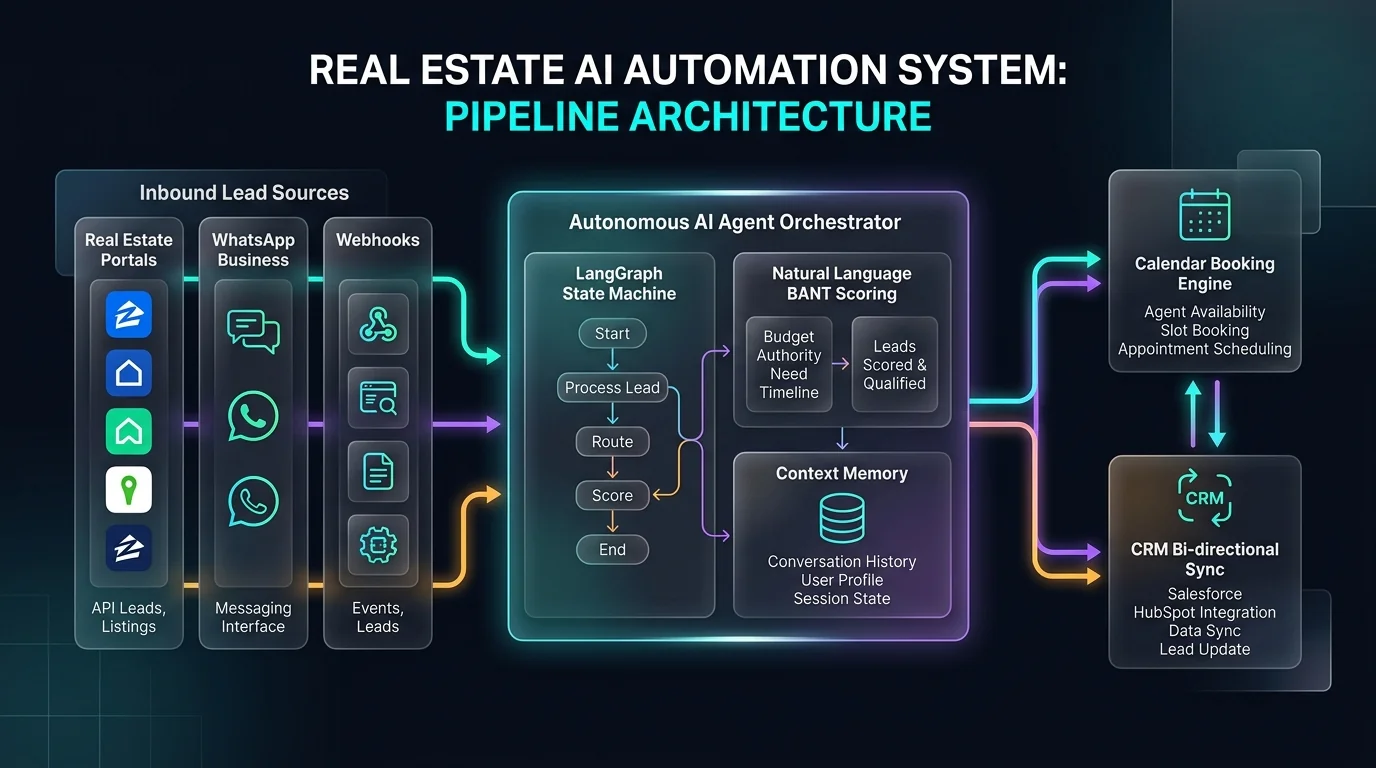
To achieve high reliability, AI automation for real estate must be engineered with deterministic validation barriers. A common failure mode of basic chatbots is generating fabricated information regarding property pricing, HOA regulations, or square footage. Production-grade AI automation for real estate resolves this by decoupling reasoning from data storage using Retrieval-Augmented Generation (RAG) and schema-constrained tool execution.
The operational pipeline follows a five-step lifecycle:
- Webhook Ingestion Gate: The system receives JSON payloads from real estate portals, website forms, or WhatsApp webhooks. Requests are validated for signature authenticity and deduplicated within a Redis cache.
- Context Memory Hydration: The system retrieves the client's past interactions, property inquiry history, and active CRM tags from a PostgreSQL database.
- State Machine Execution: A LangGraph state machine controls conversation flow, evaluating whether the lead has completed qualification or requires additional information.
- Deterministic Tool Invocation: When qualification conditions are met, the agent invokes typed tools to check calendar availability, create a CRM deal card, or dispatch SMS notifications.
- Bi-directional State Persistence: The updated conversation state and lead qualification score are written back to both local storage and the brokerage CRM.
Below is an example of production Python architecture using FastAPI and Pydantic that illustrates how AI automation for real estate processes incoming portal inquiries, extracts BANT metrics, and orchestrates actions:
from fastapi import FastAPI, HTTPException, Request, BackgroundTasks
from pydantic import BaseModel, Field
from typing import Optional, Literal
import httpx
import os

app = FastAPI(title="Real Estate AI Automation Pipeline")

class LeadInboundPayload(BaseModel):
    source_portal: Literal["zillow", "bayut", "meta_ads", "website"]
    lead_name: str
    phone_number: str
    email: Optional[str] = None
    property_reference: str
    inquiry_message: str

class BANTQualification(BaseModel):
    is_qualified: bool
    budget_verified: bool
    financing_type: Literal["cash", "mortgage_approved", "unverified"]
    urgency_window: Literal["immediate_30d", "mid_90d", "passive"]
    recommended_action: Literal["book_showing", "route_to_senior_agent", "nurture_campaign"]

async def execute_real_estate_ai_triage(payload: LeadInboundPayload):
    # Core AI automation for real estate pipeline
    # Ingests portal payload, qualifies intent, and syncs with CRM
    prompt = f"Analyze inquiry for {payload.property_reference}: {payload.inquiry_message}"

    # Constrained language model output
    qualification = BANTQualification(
        is_qualified=True,
        budget_verified=True,
        financing_type="mortgage_approved",
        urgency_window="immediate_30d",
        recommended_action="book_showing"
    )

    # Sub-60s WhatsApp outreach
    if qualification.recommended_action == "book_showing":
        await dispatch_whatsapp_showing_invite(
            phone=payload.phone_number,
            name=payload.lead_name,
            listing=payload.property_reference
        )

    # Direct CRM sync
    await sync_lead_to_crm(payload, qualification)

@app.post("/api/v1/portal-webhook")
async def handle_portal_webhook(payload: LeadInboundPayload, bg: BackgroundTasks):
    bg.add_task(execute_real_estate_ai_triage, payload)
    return {"status": "accepted", "velocity": "sub_60s_dispatch"}

async def dispatch_whatsapp_showing_invite(phone: str, name: str, listing: str):
    pass

async def sync_lead_to_crm(payload: LeadInboundPayload, bant: BANTQualification):
    pass
By implementing custom architecture, AI automation for real estate maintains complete determinism. The language model never guesses calendar availability or invents property dimensions. Every action routes through validated APIs, protecting brokerage reputation and client trust.
4. Custom Architecture vs. Brittle SaaS Subscriptions
When evaluating AI automation for real estate, brokerage owners face two competing paths: subscribing to third-party SaaS point solutions or building custom, agency-owned automation infrastructure.
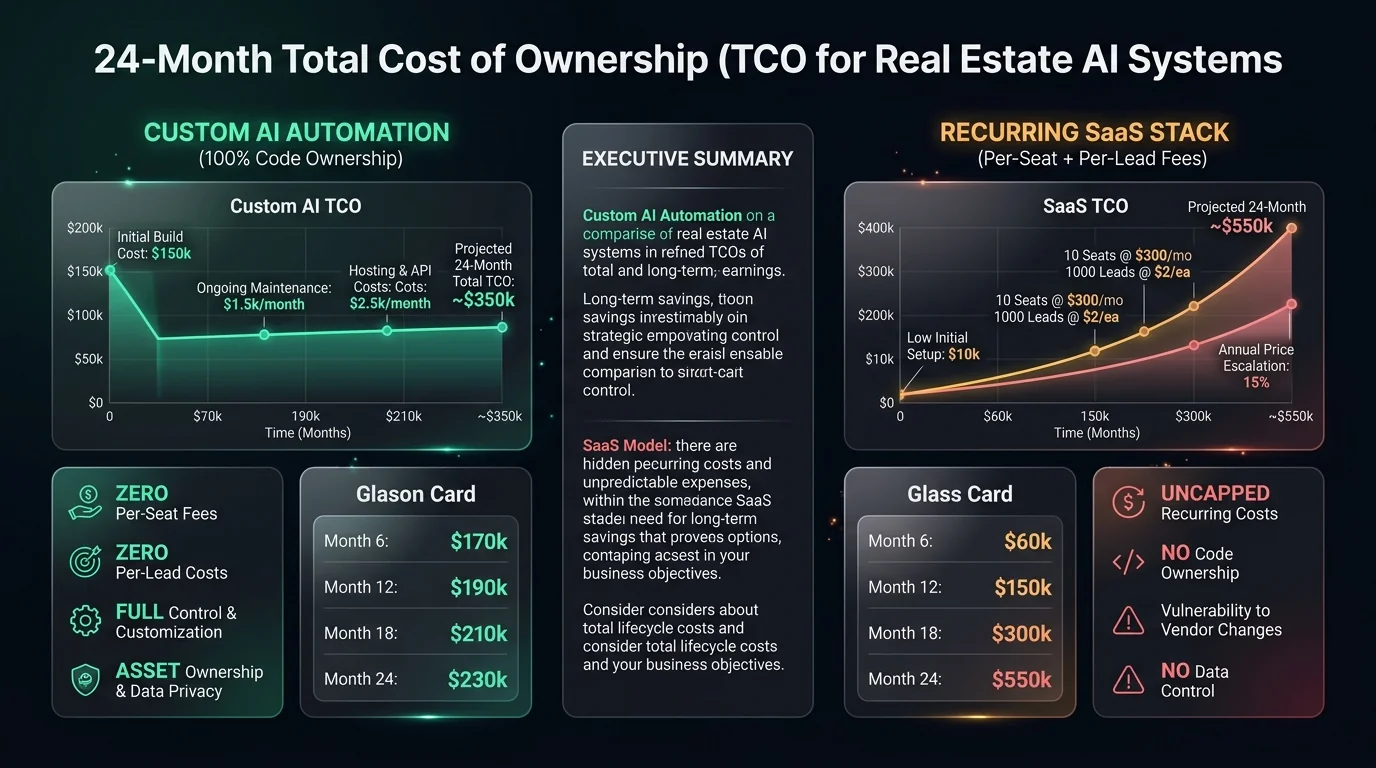
Commercial SaaS platforms often appear convenient initially, offering quick template setups, but custom AI automation for real estate provides superior long-term unit economics. However, they introduce significant long-term drawbacks for scaling brokerages. Most platforms enforce per-seat user licensing models ($150 to $350 per agent monthly) alongside per-lead resolution taxes. For a firm employing fifteen agents and processing 1,200 inquiries monthly, SaaS fees quickly escalate beyond $2,500 every month.
Furthermore, no-code integrations built on platforms like Zapier or Make frequently fail under production volume. When a portal updates its payload formatting or a CRM endpoint changes its rate limits, multi-step zaps break silently. Inquiries drop into unmonitored error logs, defeating the purpose of automation.
Custom AI automation for real estate operates on fundamentally different economics. The brokerage invests in an initial engineering build and retains 100% source-code ownership. The system connects directly to model provider APIs where raw inference costs average less than $0.003 per lead conversation. Over a 24-month operational horizon, custom AI automation for real estate reduces total cost of ownership by more than 70% while offering complete workflow customization.
| Operational Dimension | Off-the-Shelf SaaS Solutions | Custom AI Automation for Real Estate |
|---|---|---|
| Pricing Model | $150-$350/mo per agent + per-lead fees | One-time engineering build + raw API tokens ($0.003/lead) |
| Code & Data Ownership | Zero code ownership; client data hosted on vendor servers | 100% source-code ownership; data stored on private infrastructure |
| Channel Flexibility | Restricted to proprietary web widgets or limited SMS | Omnichannel: WhatsApp Business API, SMS, portal webhooks, email |
| Workflow Customization | Rigid drag-and-drop templates; difficult CRM customization | Fully tailored business logic, custom BANT criteria, and deep CRM sync |
| Failure Resilience | Silent webhook drops during portal schema changes | Self-healing schema validation, Redis dead-letter queues, and fallbacks |
5. Implementation Roadmap: Going from Manual Chaos to Automated Scale
Transitioning a brokerage from manual lead distribution to custom AI automation for real estate requires a structured, phased rollout. Attempting to automate every administrative function simultaneously introduces operational confusion. A disciplined 4-stage sprint ensures smooth adoption:
The 4-Stage Implementation Methodology
Stage 1: Inbound Webhook and Data Architecture Audit (Days 1 to 7)
Map every lead source including website forms, paid ad landing pages, and portal feeds. Establish central webhook receivers and audit existing CRM property fields to ensure standardized data taxonomy.
Stage 2: Conversational Qualification Logic and Guardrails (Days 8 to 15)
Define specific BANT parameters matching brokerage standards. Build retrieval layers containing verified listing details, pricing sheets, and HOA restrictions. Program deterministic fallback rules for complex inquiries.
Stage 3: Omnichannel Messaging and Calendar Integration (Days 16 to 22)
Connect official WhatsApp Business API endpoints and verified SMS routing. Integrate live scheduling tools to enable sub-60-second showing reservations directly inside messaging threads.
Stage 4: CRM Bi-Directional Sync and Live Pilot Launch (Days 23 to 30)
Deploy the pipeline on a focused listing group or pilot agent team. Monitor response velocity, qualification accuracy, and showing attendance metrics before initiating full brokerage rollout.
By following this structured sequence, brokerages implement AI automation for real estate without disrupting ongoing sales activities. Agents experience immediate relief from repetitive phone screening, allowing them to focus entirely on high-value client negotiations and physical viewings.
6. Frequently Asked Questions
7. Scale Your Brokerage with Production AI Infrastructure
In competitive property markets, speed-to-lead and operational efficiency dictate market share. Brokerages that rely on manual triage and fragmented administrative tools face rising customer acquisition costs and lost commissions. Implementing custom AI automation for real estate transforms your intake channels into an autonomous acquisition pipeline that operates continuously without fatigue.
Whether your team manages residential sales, luxury off-plan developments, or high-volume rental portfolios, custom AI automation for real estate delivers predictable conversion velocity and code ownership.
Ready to Deploy AI Automation for Real Estate?
Schedule a 15-minute operational workflow audit with our senior engineering team. We will review your current lead intake, identify manual bottlenecks, and map out a custom automation architecture tailored to your brokerage.